
By David A. Carrino
The Cleveland Civil War Roundtable
Copyright © 2026, All Rights Reserved
Editor’s note: This article was originally published in The Charger in March 2026.
Civil War enthusiasts are familiar with the fact that William H. Seward, the man who was the secretary of state throughout the entire Civil War, was also the person who, after the Civil War, orchestrated the purchase of Alaska for the United States. This purchase was in keeping with Seward’s stance as a staunch proponent of Manifest Destiny. By negotiating the purchase of Alaska, Seward redirected Manifest Destiny from its westward advance to a northern leapfrog over Canada (which was known as British North America at that time) and into a territory that Seward had long believed would become part of the U.S. Seward had set his sights on Alaska well before he entered into purchase negotiations in 1867, as indicated by his 1846 assertion that “our population is destined to roll its resistless waves to the icy barriers of the north.” Seward was such an ardent advocate of Manifest Destiny that he even had designs on absorbing both Mexico and British North America into the U.S. (It is not known if Seward, in a presaging of a 2026 presidential craving, wanted to also assimilate Greenland.) While Seward was never able to acquire Mexico and British North America, he did oversee, in addition to the acquisition of Alaska, the annexation of Midway Island by directing the U.S. Navy to occupy it and claim it for the U.S., which thereby pushed Manifest Destiny far westward into the Pacific Ocean.
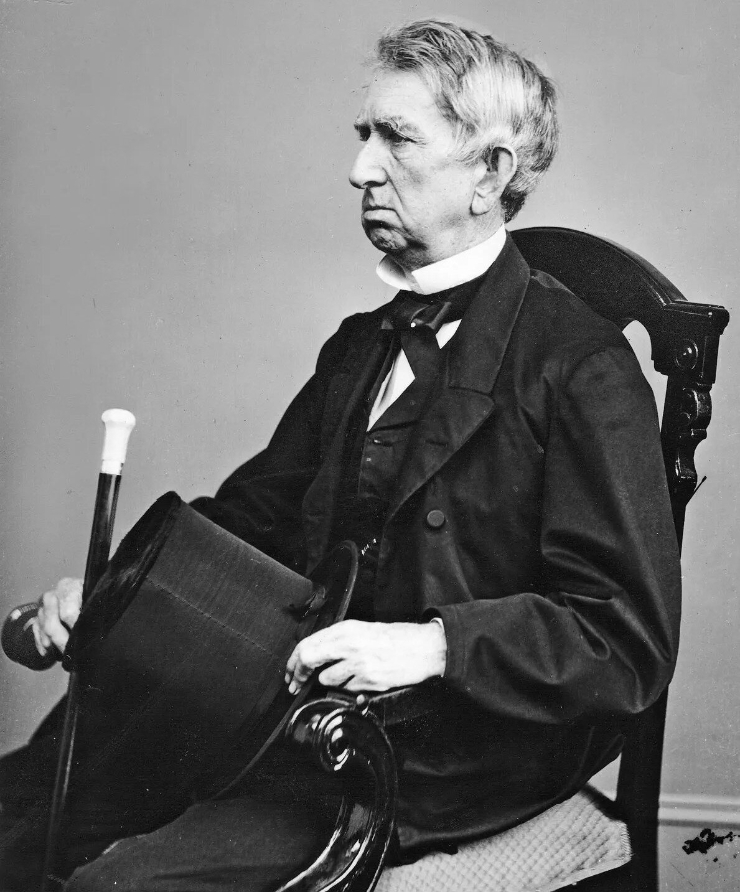
Russia had approached the U.S. about the purchase of Alaska during James Buchanan’s presidency, but the Civil War interrupted any possibility of a deal being completed. After the end of the Civil War, Russia renewed its effort to sell Alaska to the U.S., and Seward, who was then the secretary of state for Andrew Johnson, negotiated the purchase with Eduard de Stoeckl, Russia’s minister in Washington. Russia had lost interest in Alaska for a number of reasons including the difficulty of defending it and the impracticability of supporting large settlements there. A significant reason that Russia wanted to sell Alaska is that the supply of one of its major products had greatly decreased in amount. This is because the Russian settlers in Alaska were among the many members of the human race who engage in the practice of depleting living natural resources to the highest degree attainable with the technology that is available. A major product that Russia had obtained from Alaska was furs, particularly furs from sea otters, but overhunting had diminished the sea otter population so disastrously that Alaska was no longer a viable source.
After Seward and Stoeckl negotiated a deal for the sale, they signed the agreement (the Treaty of Cession) on March 30, 1867. The purchase price of $7.2 million translates to about two cents per acre (about 50 cents per acre in 2026 dollars). Despite the bargain price, not everyone in the U.S. was pleased with the purchase. Newspapers denounced the enterprise as “Seward’s Folly” and labeled the territory that the U.S. bought “Seward’s Icebox.” Horace Greeley was especially critical and asked why the U.S. should even want a “territory of ice, snow, and rock.” Maine Senator William Fessenden insisted that he would vote for the purchase only if “the secretary of state be compelled to live there and the Russian government be required to keep him there.” Fessenden’s scathing comment was ominous, since the Senate had to approve the Treaty of Cession before the sale became final.
Interestingly, Charles Sumner, who was the unfortunate target of Preston Brooks’ cane prior to the Civil War, was instrumental in the approval of the purchase by the Senate. Sumner was initially skeptical, but he spent a great deal of time and effort learning about Alaska, which convinced him that the territory was valuable. After educating himself about the derided “territory of ice, snow, and rock,” Sumner addressed the Senate for three hours about the merits of purchasing that territory, and the Senate overwhelmingly ratified the Treaty of Cession by a vote of 37 to 2. For Seward, this was a magnificent personal triumph. In fact, even though Seward helped to navigate the nation through its greatest crisis during his tenure as secretary of state under Abraham Lincoln, when Seward was asked what he considered his greatest accomplishment as secretary of state, he replied that it was the purchase of Alaska, and then he added “but it will take the people a generation to find it out.”
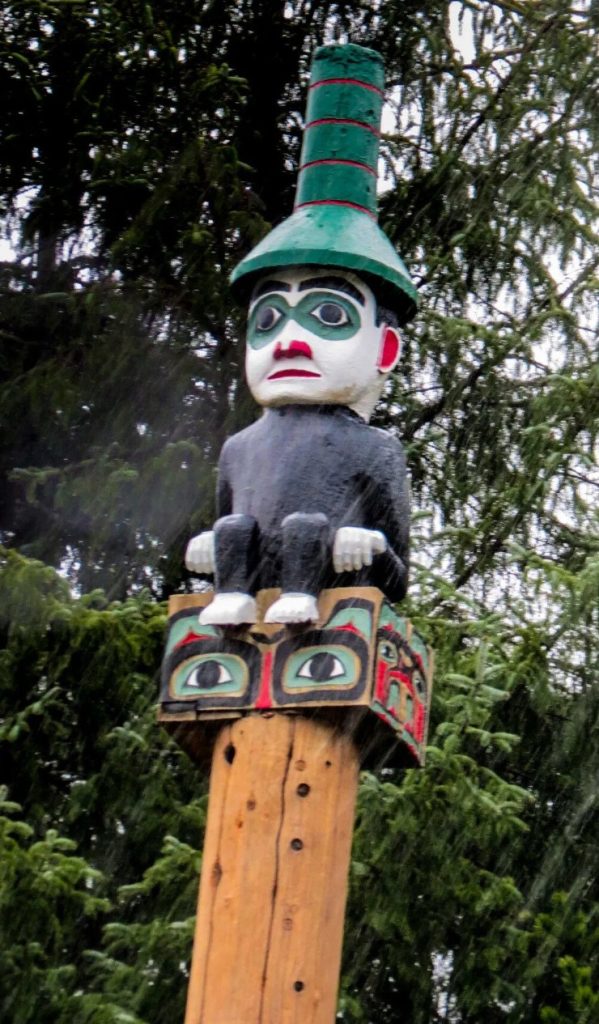
In 1869, after the election of Ulysses Grant displaced Seward from the Cabinet, the former secretary of state visited the territory whose purchase he had negotiated. One of the places in Alaska that Seward visited is Tongass Island, which is near the southern end of the Alaska panhandle. At that time, Tongass Island was home to a group of the Tlingit Indigenous people. During Seward’s visit, Chief Ebbits, the leader of the Tlingit clan that lived on Tongass Island, held a potlatch for Seward. A potlatch is a combination festival and ceremony intended to honor someone, at which the honoree is presented with a number of gifts. Tlingit custom holds that the honoree is expected to show his gratitude by reciprocating with a potlatch for the person who honored him, but Seward, perhaps because of ignorance about this custom or because of a conscious decision, never reciprocated the potlatch. When Seward did not do this and when it became clear years later that he would not, the Tlingits erected a totem pole to mark Seward’s breach of protocol.
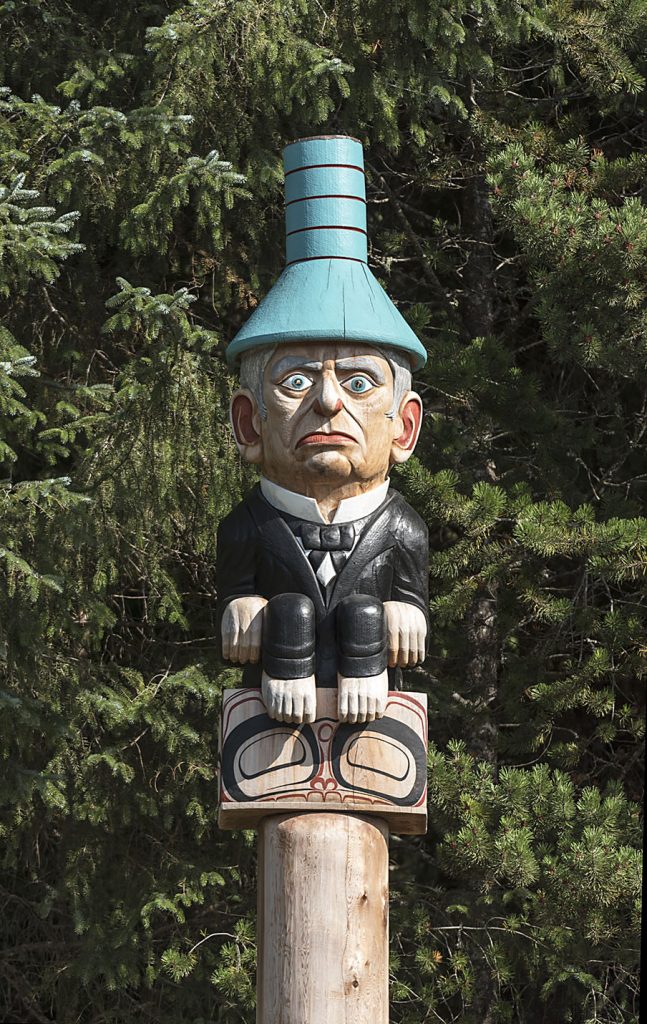
This totem pole, which was erected in the 1880s, is of a particular type known as a shame pole, because it is meant to disparage the pole’s subject. Seward’s shame pole portrayed him with a white face, wearing a potlatch hat, and with red ears and nostrils to indicate his shame. Decades later, after most of the inhabitants of Tongass Island had moved to Ketchikan and nearby areas, a replica shame pole was erected in the 1930s in Saxman, a town near Ketchikan. When this shame pole deteriorated, as typically happens with totem poles, another Seward shame pole was erected in Saxman in 2017. The most recent iteration of the shame pole depicts Seward more realistically but shows him with a bloated face, bulging eyes, a scornful facial expression, and the red ears and nostrils indicative of shame. Some of the Tlingits in Saxman stated that the shame pole is not meant so much to chastise Seward for his slight in not reciprocating the potlatch, but more to signify Seward’s failure to recognize and respect the Indigenous people of Alaska as equals.
The failure of Seward to respect the Indigenous people is abundantly clear in the terms of the Treaty of Cession. Much of the treaty deals with the specifics of the purchase and the transfer of the land. But Article III is a provision that lays out what is to happen with the people living in Alaska. This provision stipulates that the “inhabitants of the ceded territory” have the option to “return to Russia” or “remain in the ceded territory” (i.e., Alaska), whichever they prefer, and if they choose to remain in Alaska, they will receive all the rights accorded to U.S. citizens, including “the free enjoyment of their liberty, property, and religion.” The option to “return to Russia” intimates that “the inhabitants” of Alaska to whom this provision applies are the settlers from Russia who were living in Alaska at that time. But if there is any uncertainty about this, Article III states unambiguously that the rights of U.S. citizens are extended to all inhabitants of Alaska “with the exception of uncivilized native tribes.” In other words, the Indigenous people, who are labeled as “uncivilized,” are not granted the same rights as U.S. citizens. As if this provision in the treaty were not sufficiently insulting and disrespectful, when Seward, later in his Alaska trip, gave a speech about the recently acquired territory, he spoke about the “savage communities” and the “insignificant nations” of Indigenous people. He further stated that these nations are “jealous, ambitious, and violent,” as if the nation that Seward represented is not.
The failure of the Treaty of Cession to extend rights, such as liberty, to the Indigenous people of Alaska is ironic, since a recently concluded civil war in which Seward was a prominent figure resulted in the right of liberty being extended to enslaved African Americans, so it seems that Seward’s recent experiences should have taught him an important lesson about civil rights. Future events showed that the extension of rights to African Americans was implemented far more poorly than should have occurred, and a century passed before a civil rights law was enacted in the U.S. to, at least by law, ensure rights to all Americans including African Americans. But well before this civil rights law was enacted, in fact, nearly two decades earlier, a civil rights law was enacted in Alaska to ensure rights for that territory’s Indigenous people, and the leading figure in that movement was a Tlingit woman named Elizabeth Peratrovich.
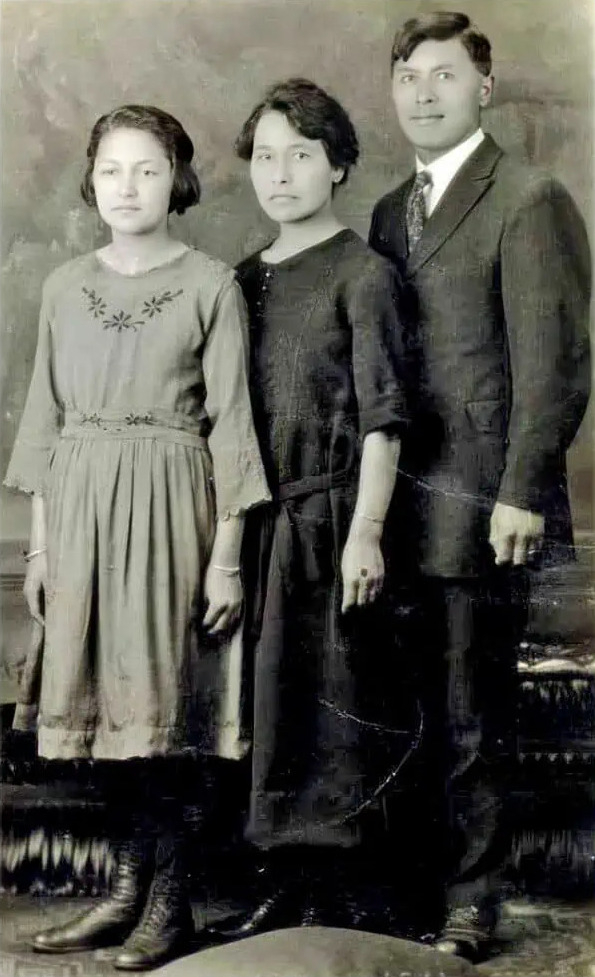
Elizabeth Peratrovich was born in 1911 in Petersburg, Alaska, a town in the Alaska panhandle that is about equidistant between Juneau and Ketchikan. Fittingly, given her future indispensable role in bringing rights to so many people, she was born on July 4. Elizabeth’s Tlingit birth name was Ḵaax̲gal.aat. Because Elizabeth’s Tlingit mother lacked the means to support her, her mother gave Elizabeth up for adoption at a very early age. She was adopted by Andrew and Jean Wanamaker, who named her Elizabeth, and she grew up primarily in Juneau and Ketchikan. Elizabeth grew up poor, but she was raised by her parents in a traditional Tlingit lifestyle. During her youth and beyond, Elizabeth experienced the rampant discrimination in Alaska directed toward Indigenous people. Wherever she went, she saw signs that read “No Natives Allowed” or “No Dogs, No Natives” or “We cater to white trade only.” Throughout Alaska, Indigenous people were barred from restaurants, theaters, schools, hospitals, and from living in certain neighborhoods.
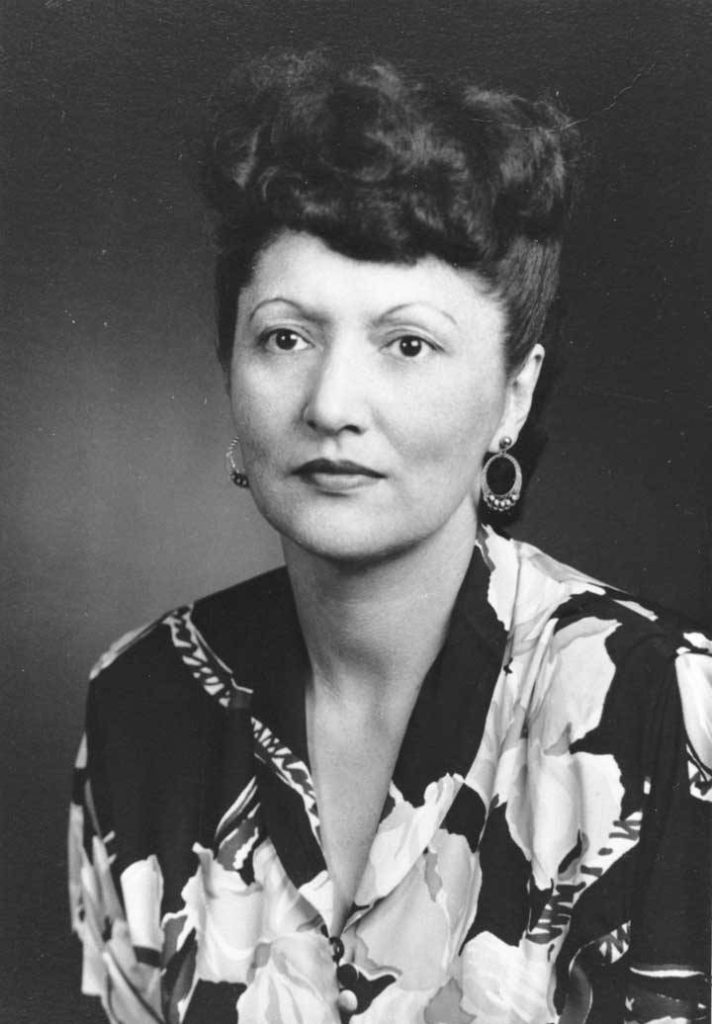
After Elizabeth graduated from high school in the same class as her future husband, Roy Peratrovich, both she and Roy attended college in Bellingham, Washington. Elizabeth and Roy, who also was a Tlingit, were married in Bellingham and then returned to Alaska in 1941. Roy and Elizabeth had three children: Roy Jr., Frank, and Loretta. While living in Juneau, the Peratroviches were looking for a house to rent, but they were repeatedly denied because they were Indigenous. After enduring so much discrimination during their lives, the breaking point came when they saw a “No Natives” sign on the Douglas Inn, a popular place in Juneau, and they decided that the time had come to end these discriminatory practices. The Peratroviches sent a letter to Territorial Governor Ernest Gruening to protest the discrimination and ask that these practices be ended. As support for their proposition, they indicated that Indigenous men had joined the military to fight in World War II, the war that the U.S. had recently entered, and they wrote, “The proprietor of Douglas Inn does not seem to realize that our Native boys are just as willing as the White boys to lay down their lives to protect the freedom that he enjoys.” This letter began their quest to end discrimination against Indigenous people in Alaska.
Gruening agreed with the Peratroviches and worked with them to craft an anti-discrimination bill and then try to push that bill through the Territorial Legislature. However, when the bill came up for a vote in 1943, it failed to pass. Undeterred by this disheartening setback, Elizabeth and Roy continued their efforts. Elizabeth traveled throughout Alaska and visited numerous towns and villages to build support among Indigenous people for a new bill. She also was able to convince some Indigenous men to run for the Territorial Legislature. When these men won their elections, it increased support for an anti-discrimination bill where that support mattered most: among those who would be deciding the fate of the bill.
In February 1945 a new civil rights bill was before the Territorial Legislature. On the day that the bill was taken up, people filled the gallery beyond its capacity and spilled into the hallway. Among those in the gallery were Roy and Elizabeth Peratrovich. There was little debate when the bill came before the House, which passed the bill by a comfortable margin of 19 to 5. But the bill’s chances for Senate passage were far less certain, because some of the senators were passionately opposed to it. Among those opposing the bill was Senator Frank Whaley. During the two-hour debate over the bill, Whaley asserted that the bill is “a natural in creating hard feelings between whites and natives.” Senator Tolbert Scott, another opponent, claimed that the issue of discrimination against Indigenous people was merely “an effort to create political capital for some legislators,” and he maintained that rather than allowing whites and Indigenous people to associate with each other, it would be better if Indigenous people “put up signs ‘No whites allowed.'” Most emphatic of all was Senator Allen Shattuck, a very staunch opponent who insisted, “Far from being brought closer together, which will result from this bill, the races should be kept further apart. Who are these people, barely out of savagery, who want to associate with us whites with 5,000 years of recorded civilization behind us?”
Some senators who supported the bill also spoke, and then, as was customary, people in the gallery were given an opportunity to make comments. Elizabeth rose from her seat in the gallery, asked to be allowed to speak, walked to the floor of the chamber, and stood before the all-male Territorial Senate. Then, calmly but forcefully and, most important, compellingly, she stated, “I would not have expected that I, who am barely out of savagery, would have to remind gentlemen with 5,000 years of recorded civilization behind them of our Bill of Rights.” She continued by describing some of the episodes of discrimination that she and Roy had experienced. After Elizabeth concluded her remarks, Senator Shattuck, in a pointed question meant to impugn the effectiveness of an anti-discrimination law, asked Elizabeth if she thought the proposed law would end discrimination. Elizabeth adroitly countered, “Do your laws against larceny and even murder prevent those crimes? No law will eliminate crimes, but at least you as legislators can assert to the world that you recognize the evil of the present situation and speak your intent to help us overcome discrimination.” As soon as Elizabeth’s final word had left her mouth, the gallery erupted in thunderous applause. The Senate passed the bill by a vote of 11 to 5, and Governor Gruening signed it into law on February 16, 1945, coincidentally in the middle of what became Black History Month.
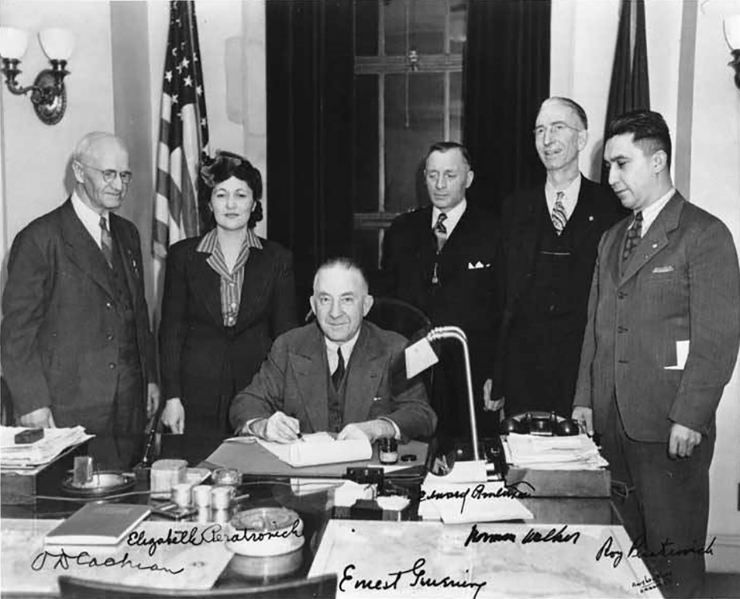
Elizabeth Peratrovich is standing second from left, and Roy Peratrovich is standing far right.
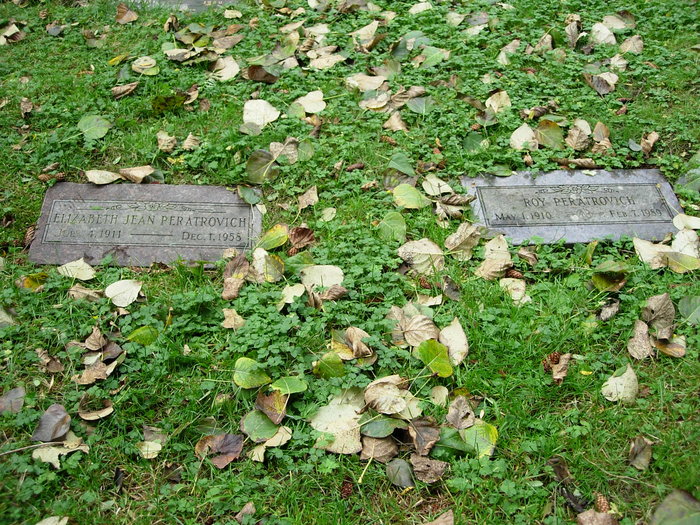
After the passage of this law, Elizabeth continued to work for equality for all people in Alaska. Sadly, she died at the young age of 47 of breast cancer on December 1, 1958, which was about one month before Alaska was admitted to the U.S. as a state. Elizabeth’s husband Roy died at the age of 78 on February 7, 1989. Elizabeth’s and Roy’s graves are next to each other in Evergreen Cemetery in Juneau.
The Alaska Anti-Discrimination Law of 1945 is recognized by some as the first viable civil rights law in America. This groundbreaking law was enacted 19 years before the landmark 1964 Civil Rights Act. Ernest Gruening, Alaska’s governor in 1945, stated that the Alaska Anti-Discrimination Law would never have passed if not for Elizabeth Peratrovich. Because of Elizabeth’s pivotal role in the quest for Indigenous civil rights, she is eminently deserving of inclusion in history’s pantheon of civil rights leaders alongside the leaders of the post-World War II African American civil rights movement. Moreover, the story of Alaska’s Anti-Discrimination Law is relevant to the Civil War, because that war was about more than preserving the Union. The Civil War was also about extending rights to a group of people who had for too long been denied those rights.
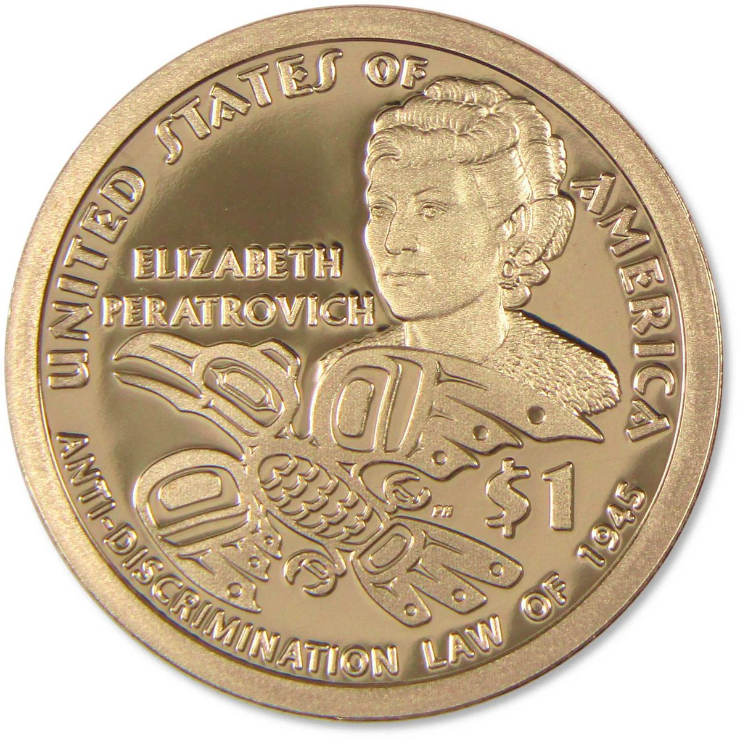
In 2020, the 75th anniversary of the passage of the Alaska Anti-Discrimination Law, the U.S. issued a one-dollar coin honoring Elizabeth. The coin bears her name and image as well as the name of the law that she championed. The coin also has the symbol of the Tlingit Raven moiety (or group) of which Elizabeth was a member. In 1992 Alaska State Representative Fran Ulmer sponsored a bill to name one of the House galleries in honor of Elizabeth. In Ulmer’s speech before the House, she pointed out that during the 1945 debate in the Alaska Senate about the civil rights law, the opponents assailed it with the same tired rationalizations that are typically used in such situations: that the law is unnecessary, that the law will intensify the bad feelings between the races, that separation of the races is a preferable state. Ulmer characterized those rationalizations as “the public face of private injustice” and then affirmed, “Those voices of prejudice were reduced to a whisper, 47 years ago, by a woman who spoke from the heart.”
In a 2025 case before the Supreme Court involving the Voting Rights Act, one of the justices posited that there is an expiration date for anti-discrimination laws. This justice claimed that “race-based remedies are permissible for a period of time, decades in some cases, but that they should not be indefinite and should have an end point.” Perhaps that contention is something best debated and resolved by legal scholars and sociologists, but that opinion is not something that is universally accepted. Ideally, there should come a time (and, in fact, should now exist) when all people recognize and respect the civil rights of all people. Such a societal state would make “race-based remedies” unnecessary. However, since even just a glance at history and at current events is sufficient to discern that we do not live in an ideal world, there is some validity to the point of view that “race-based remedies” will always be necessary, in the same way that Elizabeth Peratrovich correctly alluded to the fact that laws against larceny and murder will be necessary as long as there are thieves and murderers among us. Nevertheless, despite any difference of opinion regarding the need for an end point for anti-discrimination laws, there is never a time when America should be without civil rights for all.
Elizabeth Peratrovich’s valiant efforts to bring civil rights to a group that was deprived of these showed that she was a true American patriot and that she was as much a freedom fighter as the colonists who rebelled against England. Even though her fight for freedom occurred not in what became the first 13 states, but in what became the 49th state, the principle of liberty that guided Elizabeth’s quest was the same as that of the American colonists at the time of the Revolutionary War and of the abolitionists at the time of the Civil War: that no person is excluded from equality. In his Gettysburg Address, Abraham Lincoln stated that the U.S. is “dedicated to the proposition that all men are created equal.” By calling the principle of universal equality a “proposition,” Lincoln reduced the self-evident truth on which the U.S. is founded to a mere suggestion. Elizabeth Peratrovich turned that suggestion into a reality.
Sources
Elizabeth Peratrovich – America’s Least Known Civil Rights Activist by Sandy Levins; WednesdaysWomen
Elizabeth Peratrovich, Civil and Voting Rights Activist by Jennifer Davis; Library of Congress Blogs
A Recollection of Civil Rights Leader Elizabeth Peratrovich, 1911-1958 compiled by Central Council of Tlingit and Haida Indian Tribes of Alaska; National Museum of the American Indian
Who Is Elizabeth Peratrovich? The Story Behind the Country’s First Anti-Discrimination Law by Richard F. Weingroff; U.S. Department of Transportation, Federal Highway Administration
The 19th Amendment, Elizabeth Peratrovich, and the Ongoing Fight for Equal Rights by Erik Johnson; National Park Service
Elizabeth Peratrovich: Civil Rights Heroine, The Story of Elizabeth Peratrovich by Susan Pierce; University of Alaska
Celebrating the Life of an Important Civil Rights Activist by Marisa Page; First Nations
Elizabeth Peratrovich; Wikipedia
Honoring Elizabeth Wanamaker Peratrovich Speech by Kathleen McCoy; University of Alaska Anchorage
2020 Native American $1 Coin: Elizabeth Peratrovich; United States Mint
Remembering William Seward’s Alaska ‘folly’ by National Constitution Center Staff; National Constitution Center
Purchase of Alaska, 1867 by United States Department of State; Office of the Historian, United States Department of State
William Henry Seward; National Museum of American Diplomacy
Alaska Purchase by the Editors of the Encyclopaedia Britannica; Britannica
The Russians; Sitka National Historical Park, National Park Service
Sea Otter by Karl Schneider and Brenda Ballachey; Alaska Department of Fish and Game
Sea Otters Once Drew Russians to Alaska and the Northwest by Junius Rochester; Post Alley
Charles Sumner and the Purchase of Alaska; United States Senate
Treaty concerning the Cession of the Russian Possessions in North America by his Majesty the Emperor of all the Russias to the United States of America: June 20, 1867; The Avalon Project, Yale Law School
Transcription of Seward’s Speeches on ‘Our North Pacific States’; Alaska Historical Society
The Seward Shame Pole: Countering Alaska’s Sesquicentennial by Emily Moore; Alaska Historical Society
Brett Kavanaugh holds the future of the Voting Rights Act in his hands by Joan Biskupic; CNN