
By Daniel J. Ursu, Roundtable Historian
The Cleveland Civil War Roundtable
Copyright © 2026-2027, All Rights Reserved
Editor’s note: This article was the history brief for the September 2026 meeting of the Cleveland Civil War Roundtable.
For its 2026 field trip, the Roundtable went to the Shenandoah River Valley to study Stonewall Jackson’s 1862 Valley Campaign. Hence, this history brief focuses on four of the commanders involved in that campaign, other than General Jackson himself. The four commanders are Confederates Lieutenant General Richard Stoddert Ewell and Colonel Turner Ashby, and for the Federals, Major General Nathaniel P. Banks and Colonel Erastus B. Tyler.
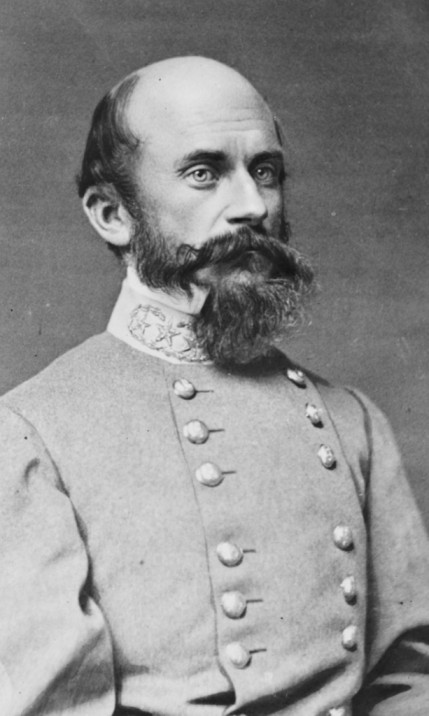
Affectionately known as “Old Bald Head” or “Baldy” by his classmates at West Point, where he graduated 13th in his class in 1840, Richard Ewell was born in Washington, D.C. in 1817, the grandson of the first Secretary of the Navy Benjamin Stoddert. After West Point, Ewell was assigned to the cavalry in the West and then fought in the Mexican-American War, where he was noted for his bravery. Afterward, he went to New Mexico and was wounded in a fight with Apaches. Despite pro-Union sympathies, Ewell sided with his state of Virginia upon secession and was appointed a colonel. He was wounded for a second time in an early skirmish at Fairfax Court House, establishing an unfortunate trend in his career. Ewell was promoted to brigadier general and commanded a brigade at First Bull Run. In January of 1862 he was promoted to major general and sent to the Shenandoah Valley in support of Stonewall Jackson.
Ewell was a quirky character, and while serving under the quirkier Jackson, Ewell doubted Stonewall’s sanity for most of the campaign. Author S.C. Gwynne states in his book Rebel Yell that “Dick Ewell was one of that impressive army of volatile, difficult, and highly idiosyncratic personalities who populated the Confederate…upper ranks. He was a slight five foot seven, with a broad, prominent dome of balding scalp above a fringe of brown hair, an angular nose, and a less than luxuriant beard and mustache…Rebel Brigadier General Richard Taylor (stated that) Ewell, with his bright, prominent eyes…and nose…bore a ‘striking resemblance to a woodcock; and this was increased by his bird like habit of putting his head on one side to utter quaint speeches’…General John B. Gordon, wrote ‘the oddest, most eccentric genius in the Confederate army. He was in truth as tender and sympathetic as a woman, but, even under slight provocation, he became externally as rough as a polar bear.” Ewell commanded a division during the Valley Campaign and in some ways can be thought of as Jackson’s “right hand man.”
The second Confederate commander described in this history brief is Jackson’s principal cavalry commander, Colonel Turner Ashby, who was born in 1828 and who, like Jackson and Ewell, was a Virginian. Ashby’s father died young, and his mother educated Turner with tutors. He later attended regular schools, but often played hooky and preferred the company of horses. He became a skillful rider and won many tournaments. In his 20s he organized a horseback militia which helped to put down frequent Manassas Gap Railroad construction worker brawls. He notably befriended grandsons of Chief Justice John Marshall, some of whom joined his militia. After John Brown’s raid at Harper’s Ferry, Ashby’s militia provided guards for Brown’s trial and execution.
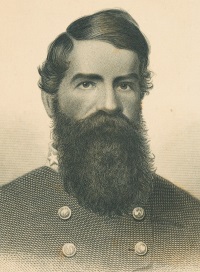
Ashby opposed secession, but he nevertheless sided with his home state when the fighting began. His militia became the 7th Virginia Cavalry. At Harpers Ferry, he was assigned to serve under Stonewall Jackson in the vicinity of the Potomac River, the Baltimore and Ohio Railroad, and the Chesapeake and Ohio Canal. During this time, his brother Richard, who served with Turner, was wounded when Richard was forced off of his mount and, while convulsing on the ground, was impaled by a Union solder with a saber, reportedly while he tried to surrender. Ashby later found his brother with blood gurgling from his mouth and witnessed his suffering and death a week later. After that incident, Ashby became a “changed man,” with a deep hatred and vitriol for the North, and he developed an intense desire for revenge and for brutal treatment of Northern soldiers.
Over time, Ashby ran afoul of Jackson due to his lax discipline over his troopers – to the point where Jackson nearly stripped Ashby of his command. James B. McPherson, in his book Battle Cry of Freedom, describes one such instance of laxness after the battle of Winchester: “Ashby’s undisciplined cavalry had disintegrated into looters, plundering Union camps or leading captured horses to the troopers’ nearby homes. Without cavalry…Jackson could not pursue the routed bluecoats.” Shelby Foote, in his The Civil War: A Narrative, Volume 1, stated, “Ashby had his faults. The main one being the inability to keep his troopers on the job when there was loot or applejack within reach, but he had established a reputation for personal bravery that was never outdone by any man in either army.”
Ashby remained the 7th Cavalry’s commander and provided much valuable reconnaissance and screening for Jackson’s Valley Campaign that contributed mightily to Stonewall’s success. In his book Rebel Yell, Gwynne describes Ashby as “dark eyed, dark skinned, heavily bearded 33-year-old (who was) by all accounts, as brilliant a pure rider as anyone in Virginia had ever seen…his dashing, reckless, romantic bravery, riding in the service of Stonewall Jackson would captivate the south. He came…to represent for many southerners everything that was noble and superior about the southern cause…a member of Jackson’s staff (said) ‘Galloping over the field on his favorite war horse, his white one, (he was) eager, watchful, fascinating and inspiring. He was the most picturesque horseman ever seen in the Shenandoah Valley.”
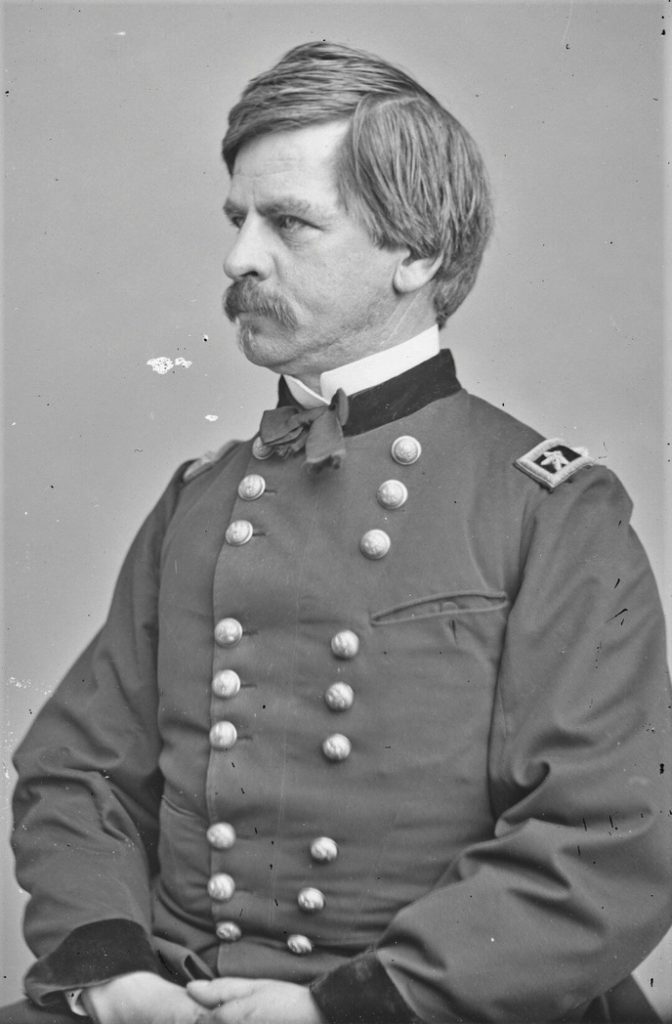
Next, and now for the Union, is Major General Nathaniel P. Banks, who was born in 1816 in Massachusetts into a financially pressed family. However, he managed to receive a solid education through his early teens. Thereafter he was forced to find employment in the thriving New England textile industry. Wanting to improve himself, Banks developed his own speaking skills and governmental knowledge by attending various speeches and lectures in the Boston area. He was known for his booming oratorial voice. Banks became smitten with politics, ran for office, and was elected a state representative by the late 1850s. Soon Banks was elected to Congress in the Know Nothing party and attempted to run for speaker. James M. McPherson, in his book Battle Cry of Freedom, states, “Banks, a onetime Democrat and then a Know Nothing, who like his colleague Henry Wilson in the Senate, now wanted to harness the Know Nothing cart to the Republican horse. The Republicans nominated Banks for speaker, but ballot after ballot, Banks fell short…The process, however, crystallized his supporters as Republicans, and when the House…finally changed the rules to allow a plurality to prevail, Banks won the Speakership…If any one moment marked the birth of the Republican party this was it.”
Continuing his meteoric political rise, Banks was elected governor of Massachusetts in 1858 and in the meantime carved out a reputation as an abolitionist. Counting on his experience in Congress, his past speakership and broad support from politicians of all political persuasions, he ran for the Republican party presidential nomination, but fell short in 1860 to none other than Abraham Lincoln. During the process, Lincoln and Banks became close friends. At the start of his first term, Lincoln, knowing Banks’ talent, nearly appointed Banks to his cabinet. Instead, at the start of the war and hoping that Banks’ political connections would help inspire enlistments and the Union cause, Lincoln appointed Banks a major general. This left many professional Union West Point graduates hot with anger and jealousy. Nevertheless, Banks was assigned to western Maryland with the aim of helping keep that state for the North.
Banks then was appointed to command the Department of the Shenandoah and experienced his first true military action during Jackson’s Valley Campaign. In fact, Banks at that time was the fourth-highest-ranking Union general and certainly the most politically prominent. At the start of the campaign, despite being a military novice, Banks had some distinct tactical and strategic advantages – and he was astute enough to recognize them – and Banks would endeavor to act. Gwynne, in his book Rebel Yell, describes Banks this way: “…a splendid looking man…Trim, compact and athletic with luxuriant, artfully tousled brown hair and a splendid military style mustache, in his sharply tailored uniform, yellow dress gloves and gleaming saber, he looked the very model of the Civil War general…Banks had what a contemporary called ‘a genius for being looked at’… he was bright, engaging and intensely ambitious. He taught himself law, was admitted to the bar at 23, and by sheer force of will dragged himself up and out of the drudgery and dead-end work of the textile mills.”
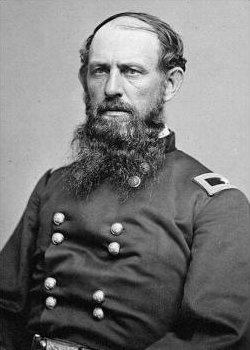
Another Union general with no formal military education was Major General Erastus B. Tyler, although he did receive an excellent college education in Ohio at Granville College, now known as Denison University. He was born in 1822 in West Bloomfield, N.Y., but as a young man moved to Ravenna, Ohio. After college, Tyler ran a fur business in western Virginia. When the Civil War broke out, he helped raise the 7th Ohio Volunteers in northeastern Ohio. In 1862 he was given command of a brigade in James Shields’ division and promoted to brigadier general. Tyler’s unit was involved in many of the Valley Campaign battles.
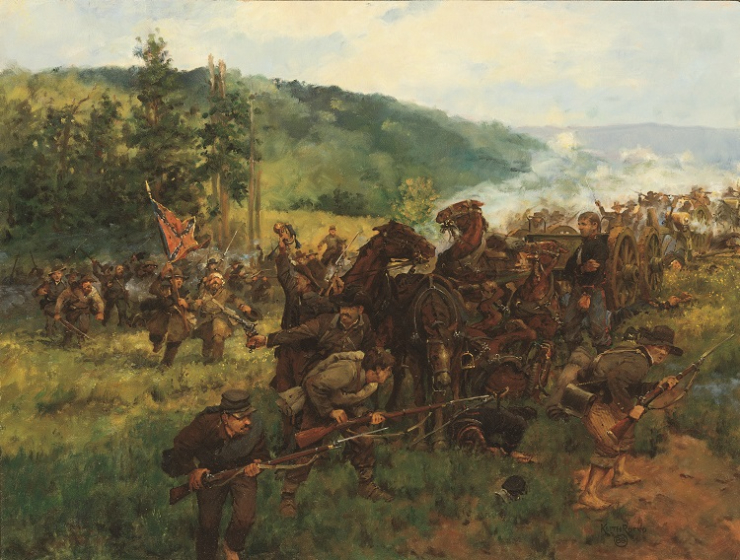
Due to circumstances, he found himself in command of the Union forces at the battle of Port Republic. Gwynne, in his book Rebel Yell, describes it this way: “two Federal brigades under…Tyler a wealthy Ohio fur merchant and one of the tougher Union fighters in the valley,..(commanding in place of General) Shields (who) was stuck in Luray 40 miles north…(but who) assured Tyler that ‘I will be with you soon’ would never show up.” Gwynne further states that for the upcoming rebel attack Tyler’s “defensive position was superb. Their right flank was anchored on the rampaging South Fork (River). Their left, a mile away across open wheatfields…anchored on an…elevated mountain…shoulder that jutted out from the foothills of the Blue Ridge, on…a flat piece of ground where charcoal had been made, known as the ‘Coaling.’ The cannons that Tyler had placed there commanded the entire river plain below.” Shelby Foote, from his The Civil War: A Narrative, Volume 1, describes it this way: “Tyler, had placed six of his sixteen guns in a lofty charcoal clearing …these guns delivered a rapid and accurate fire, enfilading the…ranks of…the (attacking) Stonewall Brigade (which) was being decimated, its ranks plowed by shells from the guns in the coaling.”
The Roundtable members who went on the 2026 field trip visited this sobering place. But as a substitute for the real site, those who were unable to go on the field trip will have opportunities to gaze at Keith Rocco’s fabulous and impressive print titled The Coaling. This print is the prize for a raffle being held by the Roundtable in the 2026-2027 season. The print will be present at all the Roundtable meetings of 2026-2027, which allows attendees a few opportunities to see it at each of the meetings. Moreover, the fortunate person who purchases the winning ticket, which will be drawn at the May 2027 Roundtable meeting, will become the print’s owner and will be able to look at the print as much as and whenever desired.
Click on the book links on this page to purchase from Amazon. Part of the proceeds from any book purchased from Amazon through the CCWRT website is returned to the CCWRT to support its education and preservation programs.