
By Thomas M. Cooper
The Cleveland Civil War Roundtable
Copyright © 2025, All Rights Reserved
Editor’s note: This article was originally published in The Charger in October 2025.
This is a story of discovery, of happenstance, of survival, of collaboration – and of gratitude.
Directly after Dan Masters’ March 13, 2024 presentation to our Cleveland Civil War Roundtable on the Battle of Stones River, I approached him about my having had two great-great grandfathers involved in that engagement – one from Ohio and one from Indiana. He asked which Indiana unit, and I recalled the 4th Battery, Light Artillery. Dan said in fact he had posted information about Capt. Asahel Bush’s 4th Indiana Battery on his website just the day before his CCWRT presentation. (See reference and website: “Reminders of the 4th Indiana Battery’s Fight along the Wilkinson Pike,” March 12, 2024.)
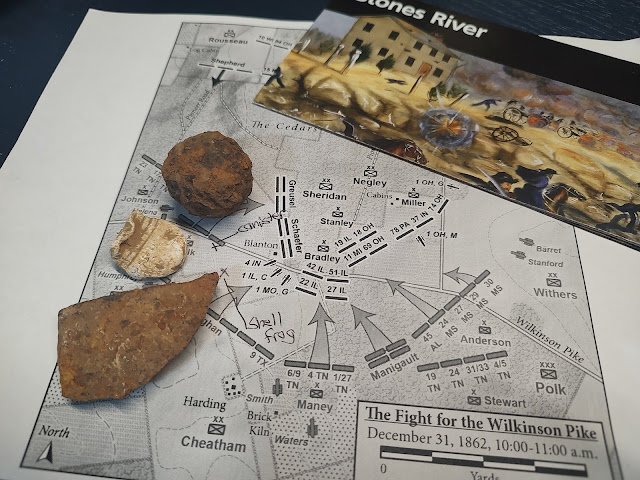
The 12-lb shell fragment was likely fired by one of Sheridan’s batteries, while the 6-lb canister ball was most likely fired by Captain Asahel Bush’s 4th Indiana Battery, which was firing canister into the flank of Lucius Polk’s brigade during the late morning of December 31, 1862.
Note the position of the 4th Indiana Light Artillery on the map.
Photograph is from Dan Masters’ Civil War Chronicles website and is used with his permission.
As Dan was in the final stages of writing his new book Hell by the Acre on the Stones River Campaign, he asked if my ancestor William Abbott was “Bill” the brother of Edgar (Ed) Abbott, both of the 4th Indiana Battery and who were described in his book related to their having been wounded – within minutes and yards of each other – on the battlefield on December 31, 1862. When I returned home, I checked my files. We were able to confirm the relationship, and Dan offered to send me Edgar Abbott’s postwar account of the events, published in Ed’s hometown newspaper, the Coshocton (Ohio) Daily Age, in 1906, obtained through Dan’s meticulous research for his book. When I received the packet containing the long article (“Ed Abbott’s Recollections of Southern Battlefields”), the first-person account and quotes of the exchange between the brothers lying on the field and in the hospital afterwards provided an astounding moment of reflection along with gratitude to Dan for his commitment to Civil War research through the stories and words of the men and women who lived it, and to the CCWRT for inviting Dan to speak, on an evening when by happenstance I was able to attend.
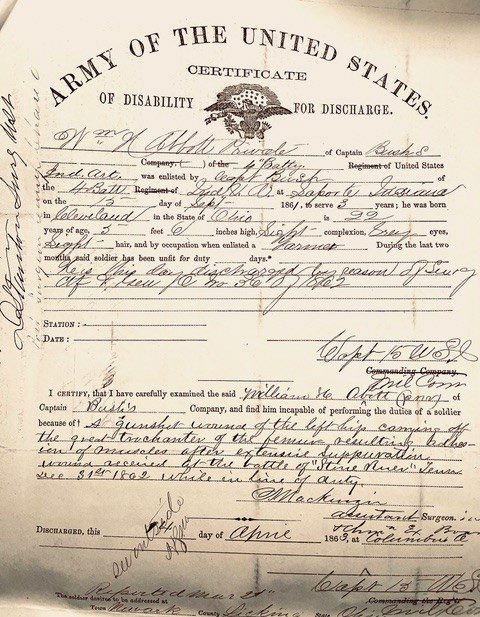
Prior to talking with Dan, I had only limited information about William Abbott’s service, including his medical discharge certification describing a major gunshot or shell wound to his hip. I knew from a letter kept by the family that he had a brother Ed, but knew nothing about Ed’s service or postwar life, let alone the battlefield account.
Born in Cleveland in 1841 and 1843, William Hampton Abbott and Edgar Gillespie Abbott were young boys when their mother died and they were raised by relatives. By ages 20 and 18 they were working as farm laborers near Valparaiso, Indiana when they answered Lincoln’s 1861 first call for troops, enlisting in Capt. Asahel Bush’s 4th Indiana, Light Artillery for a three-year term. “Well, we bade farewell to our friends, put on the blue clothes, got our equipment and started for the front, fully expecting to clean everything up and be back home in about three months…we just happened to butt in just in time to be in about all the hard fought land battles that the armies of the Cumberland and Tennessee were engaged in.”
On December 30, 1862 the 4th Indiana Battery, which had been ordered to push forward from Nashville to Murfreesboro, encountered Braxton Bragg’s army, and were surprised by fire from an eight-gun masked Confederate battery. “Our battery was a six gun battery, brass pieces, two rifle guns, two smooth bores and two howitzers…A piece of shell struck one of our lead horses at the root of the ear…but the horse did not go off his feet. Number 1 is the man that handles the rammer. Number 3 thumbs the vent and stands directly behind Number 1 while on duty at the gun. A solid six pound shot struck Number 1 under the arm while he was in the act of loading and struck Number 3 just waist high and I believe they were both in Heaven in less than two minutes…both good fellows” (quoted in Edgar Abbott’s Recollections and in Dan Masters’ Hell by the Acre, p. 197).
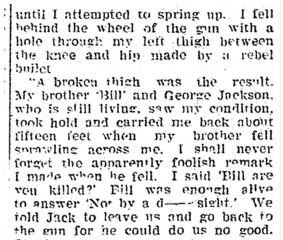
The next day, December 31, “A division of (William) Hardee’s Corps swung a heavy force around (Richard) Johnson’s Division, (Philip) Sheridan’s Division, (Joshua) Sill’s Brigade, (Alexander) McCook’s Corps, and we were forced to retire while firing in order to extricate ourselves from that position which movement was a fine piece of artillery work. Well, the battery got out but plenty of men and horses were left on the field, my brother Bill and myself among the number…in the mixup I went down but did not realize that I was hurt until I attempted to spring up. I fell behind the wheel of the gun with a hole through my left thigh between the knee and hip made by a rebel bullet. A broken thigh was the result. My brother Bill and George Jackson who saw my condition, took hold and carried me back about fifteen feet when my brother fell sprawling across me. I shall never forget the apparently foolish remark I made when he fell. I said ‘Bill, are you killed?’ Bill was alive enough to answer ‘Not by a damned sight.’ We told Jack to leave us and go back to the gun, for he could do us no good. Our boys continued to fall back and the field was lost for a time.” (See first newspaper clipping insert: Coshocton Daily Age, November 24, 1906. Also quoted in Hell by the Acre, p. 333.) “Sill, the Brigade Commander, was shot and killed not over ten feet from where I lay.”
“I could not fight, neither could I run…I thought of my father and mother. I thought of the girl I kissed and bade goodbye with a promise to return…Aye, I thought of my mother’s last words on her death bed, to be a good boy and meet her in a better place…even of the little prayer she taught me to pray… My brother said to me, ‘Ed, can you crawl?’ I answered, ‘not on my back.’ He said he would crawl down toward a fence that was not far away. I said ‘go on, we can do each other no good here. Good bye, Bill, keep a stiff upper lip and we will come out all right. If not, you know the rest.’ I saw him crawl away.”
Ed Abbott lay on the muddy field for nine days, at times watching wounded men undergo field amputations. “By the way, the board of doctors were mixed – two Federal and two Confederates. They often went over the field in that manner attending to Federal and Confederate alike.” At one point he was given a red flannel flag saturated with chloroform to hold to his nose to prepare for amputation of his leg, but by some miracle a Dr. Mitchell of the 36th Illinois, whom he had known from a previous battle, recognized him and intervened to prevent the surgery, saying he was young and strong. “Gentlemen, I know this man…If you will lay him off and trust to me I will see to it that he is properly cared for.” Mitchell promised to return shortly but for unknown reasons never was able. In the next few days some stragglers wandered by with scraps of food and water. He could hear the last gasps of the wounded lying nearby, and supposed brother Bill was dead, as he could see the burying squad down the hill with bodies in blankets. After nine days, an ambulance came and he was removed to what was once the city hotel in Murfreesboro, then to a makeshift field hospital.
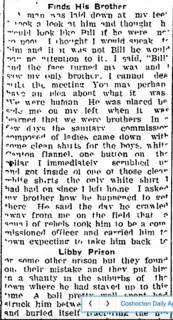
“A man was laid down at my feet. I took a look at him and thought he would look like Bill if he were not so poor. I thought I would speak to him and if it was not Bill, he would pay no attention to it. I said, ‘Bill,’ and his face turned my way and I saw my only brother. I cannot describe the meeting. You may perhaps have an idea about what it was like. We were human. He was placed beside me on my left, when it was learned we were brothers…I asked my brother how he happened to get there. He said the day he crawled away from me on the field that a squad of rebels took him to be a commissioned officer and carried him to town expecting to take him to Libby Prison or some other prison but they found out their mistake and they put him in a shanty in the suburbs of the town where he had stayed up to this time. A ball pretty well spent had struck him between the hip and ribs and buried itself fracturing the hip bone.” (See 2nd newspaper clipping insert: “Finds His Brother,” Coshocton Daily Age, December 1, 1906.)
According to Muster Roll cards, by April 1863 the brothers had been released or exchanged, and William was transferred to the USA General Hospital at Camp Chase, Columbus, Ohio, where he received a disability discharge that same month (shown below in the photograph of the discharge). They both lived for a time in Newark, Licking County, Ohio (the author’s hometown) where they appear in a military listing in June 1863 (shown below in the photograph of the Consolidated Military Listing, which is shown as a full-page view and an enlarged view). William and Edgar were the fathers of 14 children between them. William became a railroad yardmaster and died in Memphis, Tennessee in 1897. Edgar relocated to Coshocton, Ohio where he operated general merchandise stores and later became a justice of the peace and county commissioner, dying in 1924. (See below for Edgar Abbott’s obituary in the Coshocton Tribune, November 28, 1924.)
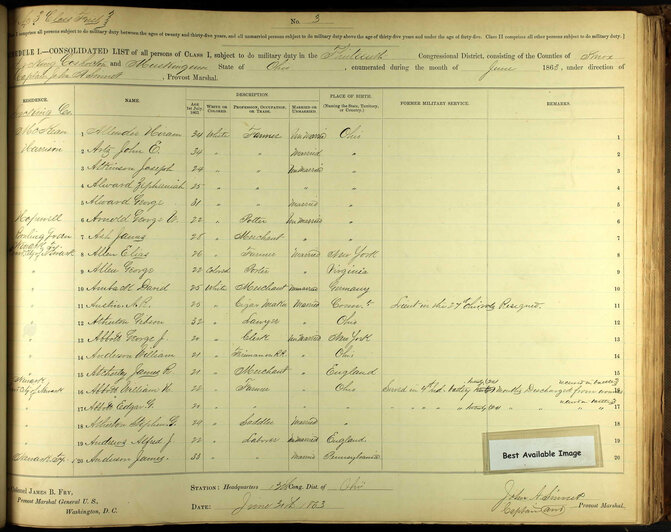
This image shows the page from the military listing on which William and Edgar Abbott were recorded (lines 16 and 17, respectively).
From Ancestry.com’s military files website.



In 2022 I had visited Stones River Battlefield (which I highly recommend to all) to track down the field locations of the units of William Abbott and another great-great grandfather, James W. Cooper of the 2nd Ohio Volunteer Infantry. (Cooper’s story, which involves his capture at Chickamauga and his release from prison thanks to a woman living in Richmond, can be found in an article on this website or in the December 2024 issue of The Charger.) Thus, by March 2024 I was particularly tuned into the details of the battle and Dan Masters’ research and writing. As it turns out, his work on the 4th Indiana Battery at Stones River and detailed knowledge of the many narratives and names from that battle and period of the Civil War had by then come into sharp focus, “aligning the planets” to allow this rich history of these Brothers in Arms (literally) to be witnessed through previously unopened doors.
Click on the book links on this page to purchase from Amazon. Part of the proceeds from any book purchased from Amazon through the CCWRT website is returned to the CCWRT to support its education and preservation programs.

References
Daniel A. Masters. Civil War Chronicles, March 12, 2024. “Reminders of the 4th Indiana Battery’s Fight along the Wilkinson Pike.”
Daniel A. Masters. (2025) Hell by the Acre. Savas Beatie (El Dorado Hills, CA).
Recollections of Corporal Edgar Abbott, 4th Indiana Battery, James C. Haddock Papers, Smith Memorial Library, Indiana Historical Society; OR 20/1:355.
Also published as: “Ed Abbott’s Recollections of Southern Battlefields,” Coshocton Daily Age, November 24 and December 1, 1906.
“E.G. Abbott Answers His Last Call: Widely Known Justice Dies from Infirmities of Age; Was Civil War Veteran,” Coshocton Tribune, November 28, 1924.