
Other than Ohio, what was the most important state, North or South, during the Civil War era? South Carolina
By Ryan Bailey
The Cleveland Civil War Roundtable
Copyright © 2026, All Rights Reserved
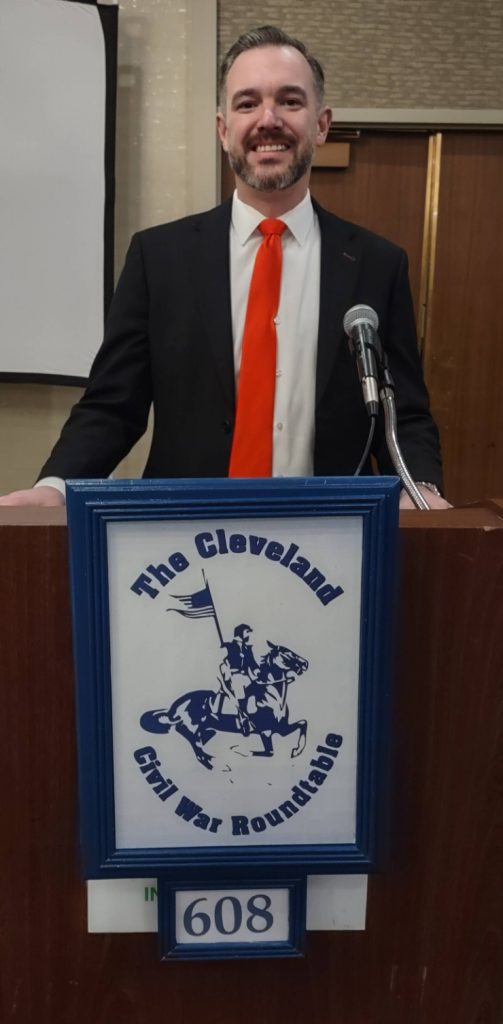
Editor’s note: The subject of the annual Dick Crews Memorial Debate at the January 2026 Roundtable meeting was: “Other than Ohio, what was the most important state, North or South, during the Civil War era?” Four members made presentations on the topic; the article below was one of those four presentations.
South Carolina and the Making of the American Civil War: Ideological Leadership, Political Escalation, and the Collapse of Compromise
Introduction
South Carolina occupies a singular position in the history of the American Civil War. It was the first state to secede from the Union, the location of the war’s opening shots at Fort Sumter, and later the focal point of some of the Union’s most punitive military actions. These facts are well known, yet they are often treated as symbolic rather than analytical. South Carolina appears as the stage on which the war began, but not as a principal actor responsible for shaping its causes and trajectory. This essay argues that such a treatment fundamentally understates South Carolina’s importance. South Carolina was the most important state in the American Civil War because it served as the ideological engine, political catalyst, and performative leader of secession, converting sectional disagreement into an organized Southern movement and ultimately into armed conflict.
South Carolina’s importance lay not merely in being first, but in leading. For decades before 1860, South Carolina’s political culture produced the most radical and confident defenses of slavery in the United States. Its leaders rejected compromise, framed antislavery politics as existential threats, and normalized violence as a legitimate response to ideological challenge. These ideas did not remain confined within state borders. They circulated widely across the slave South, shaping political norms and expectations. By the time the secession crisis arrived, South Carolina had already supplied both the ideological vocabulary and the behavioral template for disunion. The Civil War did not simply begin in South Carolina; it emerged from a political culture that South Carolina helped create and export.
Historiography and the Problem of Centrality
Civil War historiography has long debated how to measure importance and causation. Military historians have emphasized states such as Virginia, where the largest armies clashed and the war’s most famous campaigns unfolded. Economic historians have highlighted the cotton South as a whole, stressing the structural centrality of slavery to the national economy. Political historians have often focused on federal institutions, party systems, and sectional alignments. Within these frameworks, South Carolina frequently appears as a dramatic but ultimately peripheral actor – symbolically significant but materially secondary.
This essay challenges that interpretive tendency by shifting the focus from operational importance to ideological and political causation. As William W. Freehling has demonstrated, secession was not the inevitable outcome of impersonal forces but the product of sustained agitation by radical elites who exploited crises to collapse the center. South Carolina was disproportionately influential within this radical cohort. Its political leadership consistently pushed Southern politics toward absolutism, redefining compromise as dishonor and resistance as obligation.
Bertram Wyatt-Brown’s work on Southern honor further illuminates South Carolina’s role. Honor culture, deeply embedded in slaveholding societies, tied personal reputation to collective standing and justified violence as a means of restoring moral order. South Carolina’s political class was particularly adept at translating honor culture into public politics, using spectacle and coercion to discipline dissent and rally solidarity. This cultural capacity helps explain why South Carolina repeatedly set the tone for Southern responses to sectional conflict.
Rather than treating South Carolina as merely the first domino, this essay treats it as a generator of political meaning. Its leaders did not simply react to Northern pressure; they actively shaped the way the South understood that pressure and how it should respond.
Ideological Foundations: Slavery, Constitutionalism, and Radicalism
South Carolina’s ideological leadership rested on a distinctive intellectual tradition that framed slavery as both morally legitimate and constitutionally protected. John C. Calhoun’s theory of concurrent majorities and his insistence that slavery was a “positive good” provided a powerful intellectual foundation for later secessionist arguments. Calhoun rejected the notion that slavery was a temporary evil or sectional anomaly. Instead, he presented it as the cornerstone of social order and political stability.
Later figures such as Robert Barnwell Rhett and James Henry Hammond expanded this logic into explicit secessionism. Hammond’s “mudsill theory” argued that all societies required a permanent laboring class and that slavery was the most humane and efficient way to provide it. Rhett insisted that the Union itself had become incompatible with slavery’s survival. Compromise, in this view, was not prudence but surrender.


What distinguished South Carolina was not merely the presence of these ideas, but their normalization within mainstream political discourse. Radical proslavery arguments that might have remained marginal elsewhere became respectable positions in South Carolina. This ideological environment trained voters and politicians alike to see sectional conflict as zero-sum and existential.
The Caning of Charles Sumner: Ideology in Action
The caning of Senator Charles Sumner on May 22, 1856, stands as one of the clearest demonstrations of South Carolina’s ideological leadership. After Sumner delivered his speech “The Crime against Kansas,” which denounced slavery and ridiculed South Carolina Senator Andrew Butler, Representative Preston Brooks of South Carolina entered the Senate chamber and assaulted Sumner with a cane. Brooks explicitly framed his action as a defense of South Carolina’s honor, declaring that Sumner had committed a “libel on South Carolina.”
This justification is crucial. Brooks did not portray the attack as a personal quarrel or spontaneous outburst. He presented it as a political act performed on behalf of his state. The manner of the assault reinforced this message. By beating Sumner publicly and unilaterally, Brooks asserted hierarchy rather than equality. He treated Sumner not as a gentleman worthy of a duel, but as a subordinate deserving punishment. The act mirrored the disciplinary logic of slavery itself.

The response across the slave states confirms the ideological significance of the event. Southern newspapers overwhelmingly praised Brooks, framing the assault as honorable and necessary. Citizens sent Brooks replacement canes after his original broke, some engraved with messages urging further violence. Rather than isolating South Carolina, the attack galvanized Southern opinion. A South Carolina newspaper confidently predicted approval “from Washington to the Rio Grande,” revealing an expectation that South Carolina’s action would resonate broadly.
The caning thus functioned as political pedagogy. It demonstrated how to respond to antislavery speech, how to interpret insult as aggression, and how violence could be deployed to defend slaveholding society. The enthusiastic reaction from across the South confirmed South Carolina’s role as ideological leader and validated its political style.
Secession as Doctrine: South Carolina, 1860
When South Carolina seceded from the Union on December 20, 1860, it did so with clarity and confidence. Its Declaration of the Immediate Causes left little ambiguity about the reasons for disunion. The document emphasized Northern hostility to slavery, the refusal of free states to enforce fugitive slave laws, and the election of a president committed to restricting slavery’s expansion.
Unlike some later secession documents, South Carolina’s declaration made slavery central rather than incidental. It framed secession as an act of self-preservation, necessary to protect property, honor, and constitutional rights. This explicitness mattered. By clearly articulating what secession was meant to defend, South Carolina provided an ideological anchor for the emerging Confederacy.
Fort Sumter and the Forcing of War
Secession alone did not make war inevitable. Even after December 1860, possibilities for negotiation and delay remained. South Carolina’s next decisive act was to collapse those possibilities. In April 1861, Confederate forces in Charleston Harbor fired on Fort Sumter, forcing the federal garrison’s surrender. This action transformed a constitutional crisis into an armed conflict.

The decision to attack Fort Sumter was deeply symbolic. Charleston was the birthplace of secession and a center of slaveholding prestige. By initiating hostilities there, South Carolina asserted its willingness to defend its ideology through force. The attack left President Abraham Lincoln little choice but to respond militarily, prompting his call for troops and accelerating the secession of additional states.
Charleston, War, and Confederate Identity
Throughout the war, Charleston remained a symbolically charged site. Union forces devoted significant resources to capturing the city, while Confederates invested heavily in its defense. Charleston’s prolonged resistance bolstered Southern morale and reinforced its status as a Confederate shrine.
The city’s significance extended beyond strategy. Charleston represented the heart of the rebellion, the place where ideological defiance had become action. Its eventual fall in February 1865 carried moral weight, signaling the impending collapse of the Confederacy and the failure of the slave society South Carolina had championed.
Sherman, Retribution, and Moral Reckoning

The war’s final act returned focus to South Carolina. During his campaign through the Carolinas, General William Tecumseh Sherman treated South Carolina with particular severity. While military considerations played a role, Sherman also framed South Carolina as uniquely culpable for the war. His destruction of infrastructure and plantations reflected a belief that South Carolina deserved punishment as the birthplace of rebellion.
This punitive approach transformed military conquest into moral reckoning. The devastation of South Carolina symbolized the collapse of the social order it had defended so fiercely. Slavery, honor, and secession all lay in ruins.
Counterarguments and Rebuttals
Critics may argue that South Carolina’s importance is overstated, pointing to states that contributed more soldiers or hosted more decisive battles. This objection conflates operational significance with causal importance. Wars are made possible by ideas and legitimacy as much as by armies. South Carolina’s role lay in shaping the ideological and political conditions that made war conceivable and unavoidable.
Others may dismiss episodes such as the Sumner caning as aberrations. Yet Brooks’s explicit invocation of South Carolina’s honor and the widespread Southern approval demonstrate that the act resonated as a political statement. The applause mattered as much as the blow.
Finally, deterministic arguments suggest that war would have occurred regardless of South Carolina’s actions. This view underestimates contingency. Without South Carolina’s leadership, the timing, form, and escalation of the conflict would have been profoundly different.
Conclusion
South Carolina was not merely the site where the Civil War began; it was a principal architect of the conditions that made the war possible. Through ideological leadership, performative politics, and decisive escalation, South Carolina transformed sectional conflict into secession and secession into war. Its defense of slavery, its politics of honor and violence, and its willingness to force confrontation positioned it at the center of the Civil War’s origins. Understanding South Carolina’s role thus reshapes our understanding of the war itself – not as an inevitable clash, but as the product of deliberate political choices led by a state that embraced radicalism and redefined the nation’s future.
Go back to the opening remarks >>
Continue to the second argument >>

Bibliography (Click on the book titles below to purchase from Amazon. Part of the proceeds from any book purchased from Amazon through the CCWRT website is returned to the CCWRT to support its education and preservation programs.)
Freehling, William W. The Road to Disunion, Volume I: Secessionists at Bay, 1776–1854. New York: Oxford University Press, 1990.
Freehling, William W. The Road to Disunion, Volume II: Secessionists Triumphant, 1854–1861. New York: Oxford University Press, 2007.
Wyatt-Brown, Bertram. Southern Honor: Ethics and Behavior in the Old South. New York: Oxford University Press, 1982.
South Carolina. Declaration of the Immediate Causes Which Induce and Justify the Secession of South Carolina from the Federal Union. December 20, 1860.
Potter, David M. The Impending Crisis, 1848–1861. New York: Harper & Row, 1976.
McPherson, James M. Battle Cry of Freedom: The Civil War Era. New York: Oxford University Press, 1988.
Sherman, William T. Memoirs of General William T. Sherman. New York: D. Appleton and Company, 1875.