
Upcoming CCWRT Program
Wednesday, April 8, 2026 at 6:00 p.m.
April 2026 Charger Uploaded
The April 2026 issue of The Charger has been uploaded onto the Roundtable’s website. The April 2026 issue can be accessed by clicking on this link.

2026-2027 Program Schedule Now Posted
Incoming Roundtable President John Syroney has put together an excellent program for the 2026-2027 season of meetings. John’s program features a nice array of speakers and topics. The 2026-2027 program schedule, including the names of the speakers, the titles of their presentations, and detailed information about the speakers and the presentations, can be accessed by clicking on this link. Roundtable members should look forward to a terrific season of meetings after the summer break.

Latest History Brief (March 2026) Posted
Roundtable Historian Dan Ursu’s March 2026 history brief has been posted. Dan’s latest history brief is Sherman’s Atlanta Campaign, Part 4, Chattahoochee River to the Battle of Peachtree Creek. Dan’s history brief continues his discussion of William Tecumseh Sherman’s pivotal Atlanta Campaign, and it can be accessed by clicking on this link.

April 2026 Roundtable Meeting: “Civil War Medicine”
The April 2026 meeting of the Cleveland Civil War Roundtable will take place on April 8, 2026 beginning at 6:00 p.m. This will be an in-person meeting. The speaker will be Fred Marquinez, and the title of Fred’s presentation is “Civil War Medicine.”
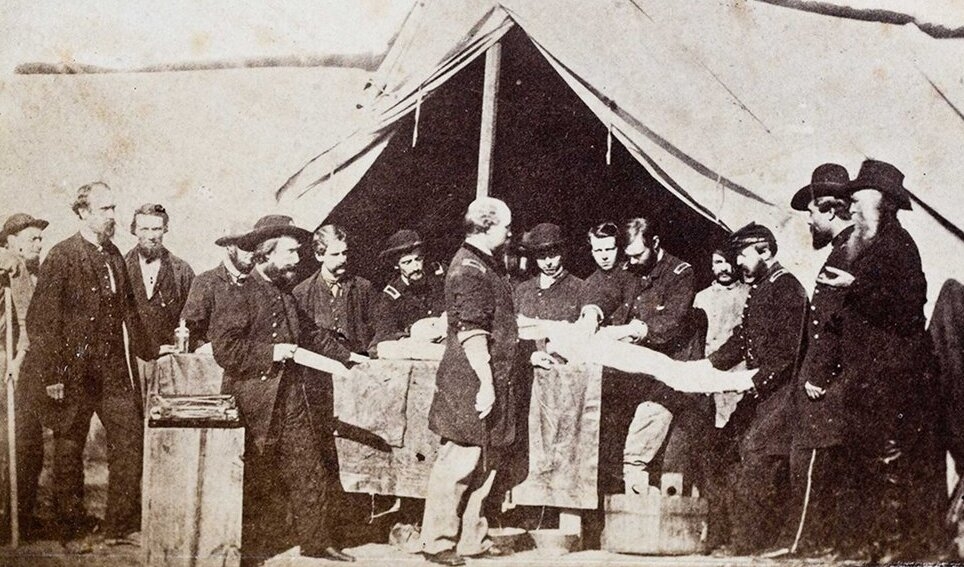
Dr. Fred Marquinez will discuss medical practices during the Civil War. At the beginning of the Civil War, the U.S. Army Medical Department was ill-prepared to handle the overwhelming number of casualties produced by the conflict. It is said that the Civil War was fought at the “end of the Medical Middle Ages,” a time of transition in medical knowledge. Papers on antisepsis and “germ theory” would not be published until years later. However, the experience gained by surgeons, the development of a system to deal with mass casualties, and the improvements in public health and nursing as well as other innovations all led to dramatic improvement in the care of wounded and ill soldiers. New standards in trauma and military medicine were established, some of which are still in use today.
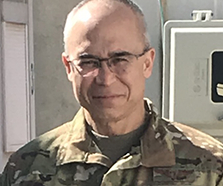
Dr. Fred Marquinez is a Medical Oncologist and a Clinical Associate Professor of Internal Medicine at Northeast Ohio Medical University. A lifelong Northeast Ohioan (born in Akron and raised in Kent), Dr. Marquinez graduated from Northeast Ohio Medical University in 1985. He completed an internal medicine residency at St. Thomas Medical Center (now Summa Health-St. Thomas Campus) in Akron and a hematology/oncology fellowship at Henry Ford Hospital in Detroit. He is also a Flight Surgeon and the Commander of the 179th Medical Group in the 179th Cyberspace Wing, Ohio Air National Guard, United States Air Force.
The April 2026 meeting will be held at the Holiday Inn Independence (6001 Rockside Road, Independence, Ohio 44131). Reservations should be made by sending an email to the Roundtable’s reservation email account (ccwrtreserve@gmail.com). Reservations must be made no later than eight days before the meeting (i.e., no later than March 31, 2026). When making a reservation, please include your name and the number and names of any guests. Please also indicate the meal choice for you (and any guests). The three meal options are Tuscan chicken, pasta primavera with grilled chicken, and stacked eggplant parmesan. If a reservation needs to be canceled, it must be canceled no later than April 7, 2026. Dinner will be provided to anyone who has a reservation. The cost of dinner is $35 per person. It is not necessary to purchase dinner in order to attend the meeting, but reservations are requested from everyone in order to have sufficient chairs set up in the meeting room. Those who plan to attend the meeting without purchasing dinner should indicate “no dinner” when they make a reservation. Other details can be found on the Reservations web page by clicking on this link.

Meeting Summary: March 2026 – “From Battlefield to WAC Training Center: Chickamauga beyond the Civil War”
The March 2026 meeting of the Cleveland Civil War Roundtable featured an exceptional presentation by Molly Sampson. Molly’s presentation described the history of the Chickamauga battlefield after the Civil War. This thoroughly engrossing discussion focused on how the battlefield became a military training complex that was used in three different wars: the Spanish-American War, World War I, and World War II.
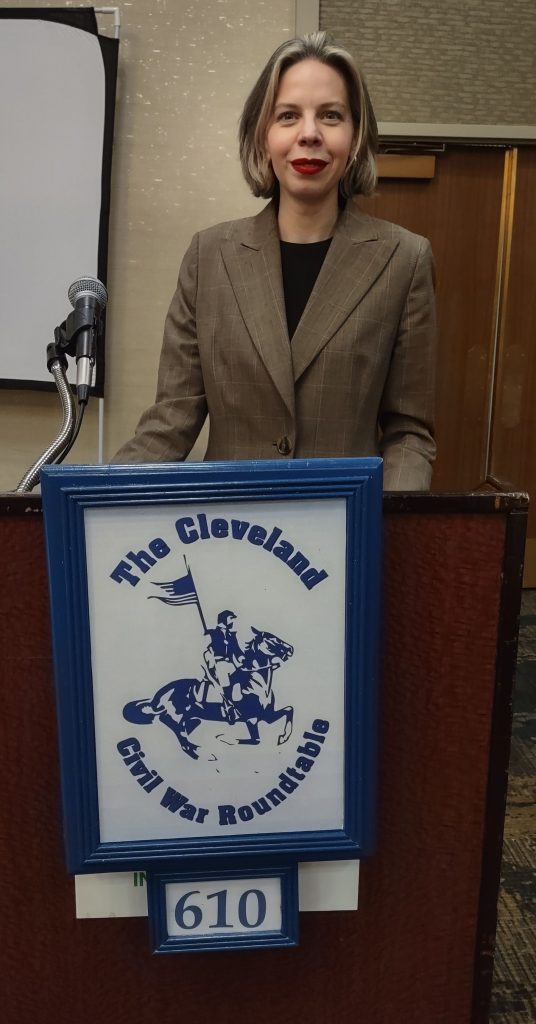
As Molly discussed, late in the 19th century, a movement arose in the U.S. to preserve Civil War battlefields as a way of memorializing the sacrifices of those who fought there. This movement was spearheaded by Henry Boynton, who was wounded at the Battle of Chickamauga. Because a large number of Civil War veterans were members of Congress at that time, there was strong sentiment in the federal government in favor of this endeavor. Consequently, Congress appropriated funds to purchase the land at the Chickamauga battlefield. This purchase was finalized when the bill was signed by President Benjamin Harrison, and preservation efforts then began. An especially striking feature of the memorials at Chickamauga is that both sides were commemorated.
Initially the administration of the battlefield was under the aegis of the Department of War. As Molly pointed out, this played a significant role in the battlefield’s history, because it led to the land being used as a military training center, in particular for cavalry. This, as Molly stated, was not the kind of battlefield preservation that we think of today, but it was extremely valuable for the U.S. Army. Fort George H. Thomas, which was constructed on the battlefield, became a very important training facility for troops who served in the Spanish-American War. After that war, Fort Oglethorpe was built on the battlefield, and this fort was used as a cavalry post. At Fort Oglethorpe, intense training resulted in the U.S. Army developing one of the best horse cavalries in the world. Moreover, as Molly noted, the men at Fort Oglethorpe used their leisure time to play polo and became very skilled at it.
With the entry of the U.S. into World War I, the Chickamauga battlefield was used to train troops for that war. This training included practice in the digging of trenches, which, as Molly again emphasized, did not align with battlefield preservation in the sense that we think of. In addition, a prisoner of war camp was built on the Chickamauga battlefield. This prisoner of war camp housed many German prisoners, and Molly related the interesting story of the most famous one: Karl Muck. Muck was the German-born conductor of the Boston Symphony Orchestra who was accused of being sympathetic toward his native Germany after the orchestra did not play the “Star-Spangled Banner” prior to a concert. However, this, as Molly described, may have been a pretext to imprison Muck, while the real reason for his imprisonment may have been the fact that Muck was allegedly having an affair with Rosamond Young, a soprano singer with the Boston Symphony Orchestra. This incident was one of a number of interesting anecdotes that Molly included in her engaging presentation. Molly also noted that during the period between the World Wars, the Chickamauga battlefield served as a primary location for the cavalry to train for the transition from horse cavalry to mechanized cavalry.
The highlight of Molly’s presentation was her discussion of Fort Oglethorpe as a training facility for members of the Women’s Army Corps (WAC) during World War II. This extensively researched and beautifully presented discussion conveyed the crucial contributions of the WACs to the war effort. Among those essential contributions, the WACs served as mechanics and medical technicians, they tested equipment, such as communication equipment, they inspected food, such as meat, that would be consumed by the servicemen, and they served in clerical and administrative functions. Molly also pointed out that a number of WACs who were trained at Fort Oglethorpe were deployed overseas during the war. In all, about 50,000 women were trained as WACs at Fort Oglethorpe, including some members of the segregated 6888th Postal Battalion, which was the only all-Black WAC unit to serve overseas. As the war came to an end, Fort Oglethorpe transitioned to a processing center for returning servicemen, and then in 1946 it was decommissioned. By this time, the Chickamauga battlefield had been transferred from the Department of War to the National Park Service, which allowed the battlefield to transform from a military training site to the kind of battlefield park with which we are familiar today.
Molly’s exceptional presentation gave the attendees at the meeting a thorough understanding of the post-Civil War history of the Chickamauga battlefield via Molly’s detailed description of the progression of that battlefield from killing field to military training facility to its current state as a well-preserved memorial to the Civil War battle that took place there. The Roundtable is extremely grateful to Molly for her outstanding and engrossing presentation.

Roundtable 2026 Field Trip – Save the Dates
The Roundtable’s 2026 field trip is scheduled for September 17-20, 2026 to the Shenandoah Valley to study the 1862 Valley Campaign. A block of rooms has been reserved, and the itinerary has some very enticing activities on it. As of now, the following activities have been scheduled for the 2026 field trip: the First Battle of Kernstown, the Battle of Front Royal, the First Battle of Winchester, the Battle of Cross Keys, and the Battle of Port Republic. Check back for updates. A downloadable PDF containing information about the hotel, the tentative itinerary, and information about signing up for the field trip can be found by clicking on this link.


Membership Roster and Contact Information
We have worked very hard to improve our membership database and contact information this year, but we know we probably have more work to do. Please be sure to keep us advised of changes in contact information by sending us the information at clecwrt@gmail.com. We monitor that email account on a regular basis, so this would be a big help in making sure we can keep you informed of group activities. If you want to see what has been posted on our Facebook page or Twitter account, you do not have to become a member of the Roundtable. Everyone is welcome to view our Facebook page and Twitter account. These can also be accessed by googling “Cleveland Civil War Roundtable” and either “Facebook” or “Twitter” and clicking on the appropriate link in the search results.

Cleveland Civil War Roundtable Monthly Meetings
Meeting Time: Monthly meetings of the Cleveland Civil War Roundtable are typically held on the second Wednesday of the month from September through May. Meetings ordinarily begin with a social hour at 6 p.m., followed by dinner at 6:30 p.m. and the program at 7:00 p.m. Meetings usually end by around 9:00 p.m. All of our meetings are currently held in person, and barring any future health-related restrictions, we anticipate that all meetings will be held in person.
Meeting Location: In-person meetings are held at the Holiday Inn Independence, 6001 Rockside Road, Independence, Ohio 44131.
Reservations: For in-person meetings, you must make a dinner reservation for any meeting you plan to attend. Reservations must be made no later than eight days prior to the meeting (so we can give a head count to the caterer). For information on making a dinner reservation, click on this link. It is not necessary to purchase dinner in order to attend a meeting. Anyone is welcome to attend the presentation without purchasing dinner. We ask that people who are not purchasing dinner make a reservation so that enough chairs will be set up in the meeting room. Simply make a reservation at the reservation email address (ccwrtreserve@gmail.com) and indicate “no dinner” in the reservation. If dinner is not purchased, there is no charge to attend a meeting.